Eat Your Skincare: 8 Foods for Acne-Prone Skin, and the Studies Behind Them
Oysters, salmon, lentils, kimchi and more: the foods with nutrients linked to clearer skin, what each study actually found, and how to add them without cutting the foods you love.
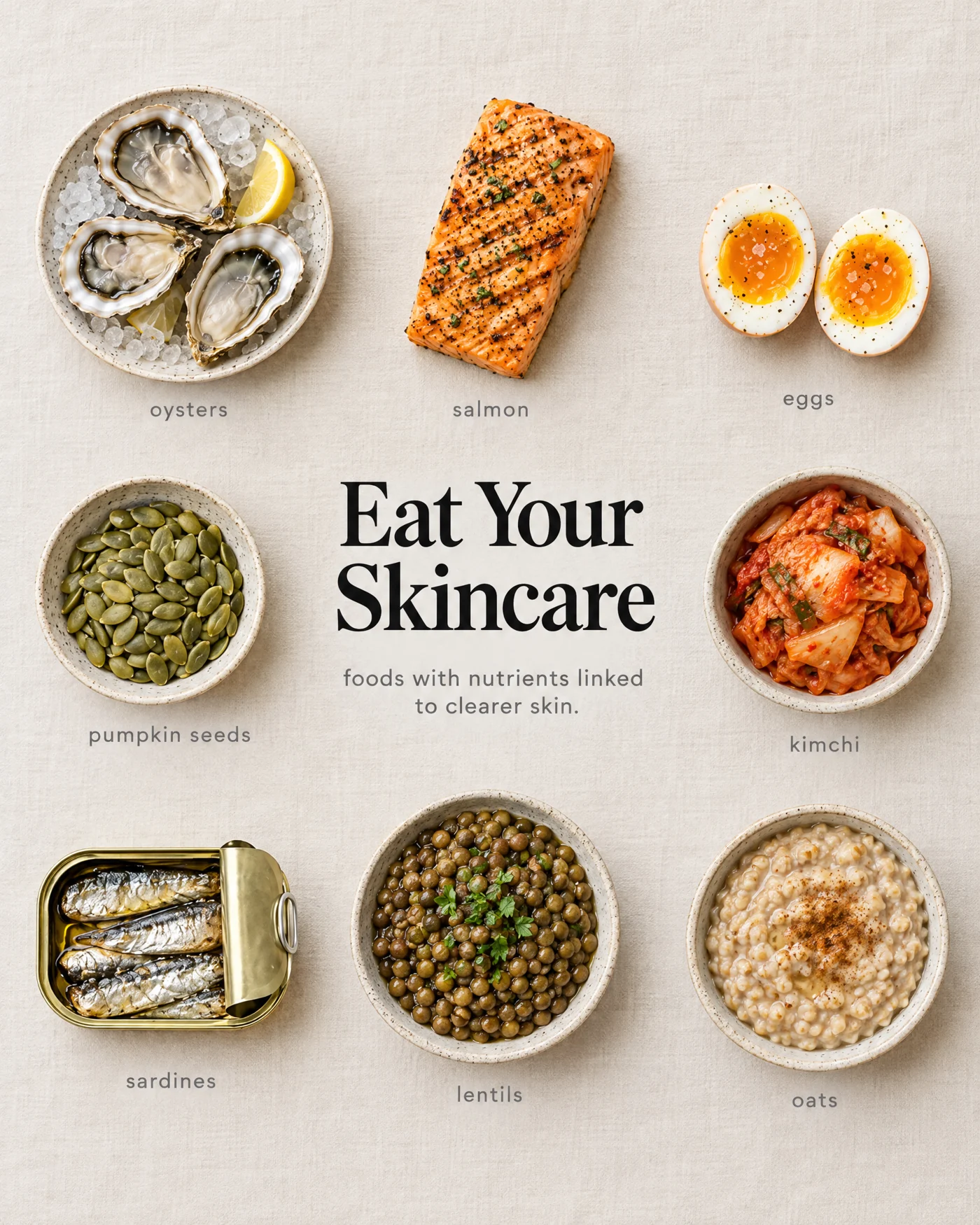
The foods with the best research for acne-prone skin are the ones that bring zinc, omega-3, slow-digesting carbs, live cultures and vitamin D: oysters, pumpkin seeds, salmon, sardines, lentils, oats, kimchi and eggs. None of them clears acne on its own, and most trials used supplements rather than food, but each one adds a nutrient that studies have linked to fewer or milder breakouts.
That's the idea behind eating your skincare: add first, before you cut. Here is each food, what the study behind it found, and how strong that evidence really is.
The list at a glance
| Food | Nutrient | What the research found |
|---|---|---|
| Oysters, pumpkin seeds | Zinc | People with acne tend to have lower zinc, and zinc treatment reduced red, inflamed spots (2020 review) |
| Salmon, sardines | Omega-3 | In 2014, a 10-week trial of 45 people found omega-3 capsules meant fewer spots |
| Lentils, oats | Slow carbs | In 2007, a 12-week trial of 43 young men found a low-glycemic diet meant fewer spots |
| Kimchi | Live cultures | A 2025 review of 9 trials (623 people) found probiotics helped a little |
| Eggs | Vitamin D | A 2022 review of about 2,400 people found lower vitamin D in people with acne |
Oysters and pumpkin seeds: zinc
Oysters are the richest food source of zinc, and pumpkin seeds are one of the best plant sources. A 2020 review in Dermatologic Therapy pooled studies comparing people with and without acne. People with acne had lower zinc levels in their blood, and those treated with zinc had fewer red, inflamed spots than those who weren't, with no more side effects than the comparison treatments.
The catch: those trials used zinc pills or creams, not oysters. Food won't match a supplement dose, but it's an easy way to make sure you aren't running low. If you're thinking about zinc pills, check with a doctor first, because high doses can upset your stomach and interact with some antibiotics.
Salmon and sardines: omega-3
Oily fish is the main food source of the omega-3 fats EPA and DHA, which help calm inflammation. In a 2014 randomized trial in Acta Dermato-Venereologica, 45 people with mild to moderate acne were split into three groups for 10 weeks. The group taking 2,000 mg of omega-3 a day had fewer inflamed and non-inflamed spots, and skin samples showed less inflammation.
It was a small trial, and it used capsules. Two servings of salmon or sardines a week is a realistic food version, and sardines are one of the cheapest ways to get there.
Lentils and oats: slow carbs
Foods that raise your blood sugar quickly (white bread, sugary drinks, sweets) push up insulin and a related hormone, IGF-1, that can drive oil production. Lentils, beans and steel-cut or rolled oats digest slowly instead.
This is the diet change with the best trial support. In a 2007 study in The American Journal of Clinical Nutrition, 43 young men aged 15 to 25 ate either a low-glycemic-load diet or a high-carb diet for 12 weeks. The low-glycemic group's spot counts dropped about twice as much (an average of 23.5 fewer spots, versus 12 fewer). A 2018 trial of 66 adults with moderate to severe acne found that just two weeks of low-glycemic eating lowered IGF-1.
You don't have to give up bread or rice. Swapping some of your fast carbs for slow ones is enough to try. For the full picture on sweets and soda, see does sugar cause acne.
Kimchi: live cultures
Kimchi, sauerkraut, miso and kefir all contain live bacteria, part of the reason the gut and skin are linked. A 2025 review in Clinical and Experimental Dermatology pooled 9 trials with 623 people. After 12 weeks, people taking oral probiotics had milder acne and about 10 fewer spots on average.
Those trials used probiotic capsules with specific strains, so a spoonful of kimchi isn't the same thing. Fermented foods are a low-risk way to support your gut while the research catches up. For the full picture, see the guide on gut health and acne.
Eggs: vitamin D
Egg yolks, oily fish and some mushrooms are among the few foods with vitamin D. A 2022 review in Dermatology combined 13 studies of about 2,400 people and found that people with acne had lower vitamin D levels, had about three times the odds of being deficient, and had lower levels the more severe their acne was.
That's a link, not proof. Low vitamin D might be a factor, or it might just travel with other habits. If you suspect you're low, a simple blood test is more useful than guessing.
What didn't make the list
Green tea gets a lot of credit for skin, but a 2021 review of 5 trials found the benefit came mostly from green tea applied to the skin, and drinking it or taking it as a pill made very little difference. Enjoy it, but don't count on it.
The 2024 acne guidelines from the American Academy of Dermatology also make no diet recommendations at all. Food is a helpful addition, not a replacement for treatment.
What this means for your skin
- Add before you cut. Work two or three of these foods into your week. It's easier to keep up than an elimination diet, and you don't lose the foods you love.
- Give it 10 to 12 weeks. That's how long the trials ran. Skin changes slowly.
- Change one thing at a time. If you add everything at once, you won't know what helped.
- Keep your treatment steady. Diet works best alongside a plan your dermatologist supports.
- Track it. Everyone's skin is different, so track what works for yours. The Root Cause app scans your meals and your skin and shows which foods your skin does better after, so the foods on this list become your own short list.
Frequently Asked Questions
What foods are best for acne-prone skin?
Foods rich in zinc (oysters, pumpkin seeds), omega-3 (salmon, sardines), slow-digesting carbs (lentils, oats), live cultures (kimchi) and vitamin D (eggs, oily fish) have the best research behind them. None of them clears acne on its own, but each brings a nutrient that studies have linked to fewer or milder breakouts.
Is there one diet that clears acne?
No. The 2024 American Academy of Dermatology acne guidelines make no diet recommendations, because the evidence is still limited. The diet with the strongest trial support is a low-glycemic-load diet, and even that showed a modest effect. Food works best as an addition to a treatment plan your dermatologist supports.
Do I need supplements instead of food?
Most of the trials used capsules, not food: zinc pills, omega-3 capsules and probiotic supplements. Food gives you the same nutrients in smaller amounts, plus fiber and other benefits. If you want to try a supplement, ask a doctor first, especially zinc, which can upset your stomach or interact with antibiotics.
How long does it take for food changes to show in your skin?
The trials ran for 10 to 12 weeks before measuring results. Skin turns over slowly, so give any change at least two to three months, change one thing at a time, and track how your skin responds so you can tell what actually helped.
Should I cut dairy or sugar too?
Not across the board. Some people react to certain foods and others don't. Adding helpful foods first and then testing one suspected trigger at a time tells you far more than cutting whole food groups at once.
Sources
- Serum zinc levels and efficacy of zinc treatment in acne vulgaris: A systematic review and meta-analysisDermatologic Therapy, 2020
- Effect of dietary supplementation with omega-3 fatty acid and gamma-linolenic acid on acne vulgaris: a randomised, double-blind, controlled trialActa Dermato-Venereologica, 2014
- A low-glycemic-load diet improves symptoms in acne vulgaris patients: a randomized controlled trialThe American Journal of Clinical Nutrition, 2007
- A Low Glycemic Index and Glycemic Load Diet Decreases Insulin-like Growth Factor-1 among Adults with Moderate and Severe AcneJournal of the Academy of Nutrition and Dietetics, 2018
- Efficacy of oral probiotics in patients with acne: a systematic review and meta-analysis of randomized trialsClinical and Experimental Dermatology, 2025
- Association between Vitamin D Level and Acne, and Correlation with Disease Severity: A Meta-AnalysisDermatology, 2022
- The effects of green tea on acne vulgaris: A systematic review and meta-analysis of randomized clinical trialsPhytotherapy Research, 2021
- Guidelines of care for the management of acne vulgarisJournal of the American Academy of Dermatology, 2024
This guide is educational and is not medical advice. Acne has many causes. Talk to a dermatologist or doctor before changing your diet or treatment, especially if you take prescription acne medication. Everyone's skin is different, so track what works for yours.